CASE STUDY 02 · scenario-based · custom animation · safety & community
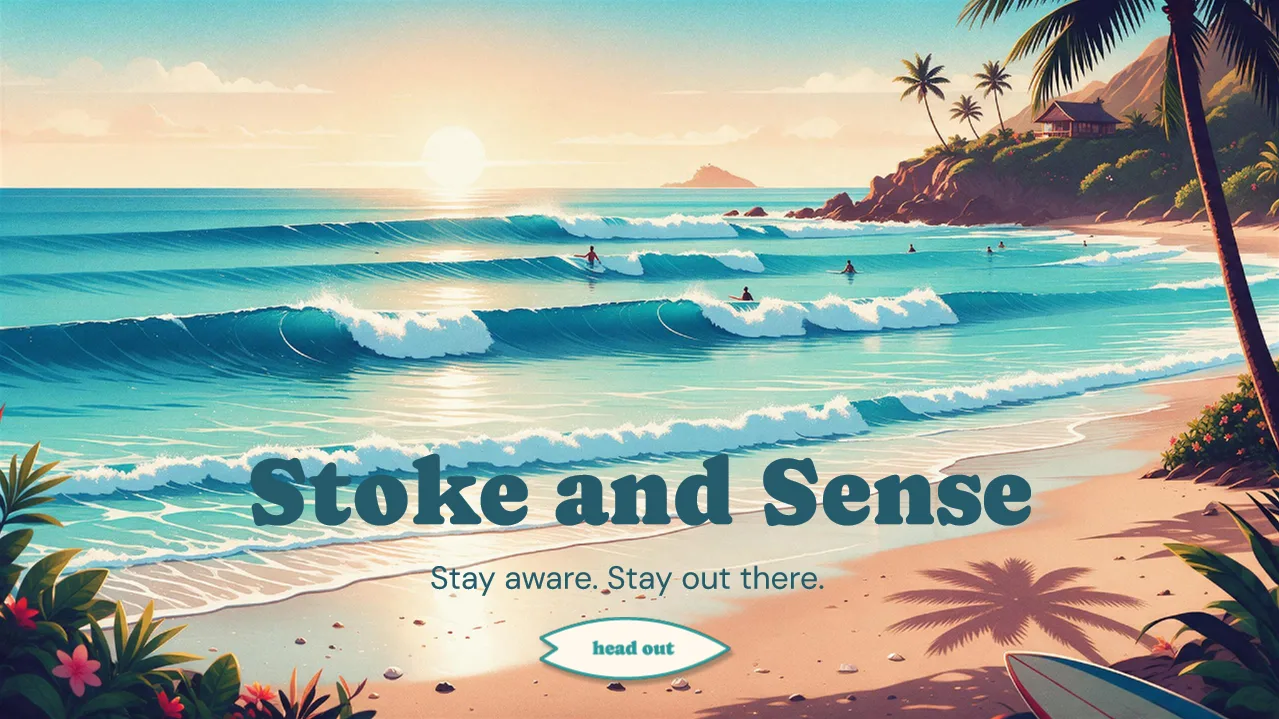
Stoke & Sense
Help Abi navigate an unfamiliar surf break, manage frustration and social pressure, and make safer calls before impulse takes over.
Client
CoastWise Collective: [conceptual]
Role
Instructional design · scenario writing · action mapping · Storyline 360 development · storyboarding · prototyping · visual design
Deliverables
Scenario-based eLearning · self-reflection tool · reset infographic · decision cheat sheet
Tools
Articulate Storyline · Figma · Magnific · ElevenLabs · Sora · ChatGPT · Suno
01 – The problem
Knowing the rules wasn’t enough.
CoastWise Surf Collective is a fictional coastal safety partnership supporting several high-traffic recreational surf beaches and around 250,000 seasonal beach users, including beginner and intermediate surfers.
For CoastWise, that meant preventable collisions, lineup conflict and risky behaviour. The goal was to help surfers read the lineup, respect priority and choose safer paddle lines before poor decisions became incidents.
Many developing surfers know the basic rules of surf safety and etiquette. The problem is applying them in the water – particularly at unfamiliar breaks, where excitement, frustration, fatigue and social pressure can quickly affect judgement.
The challenge wasn’t simply knowing what a surfer should do.
It was being able to notice what matters before acting on impulse.
02 – The solution
Put the learner in the lineup.
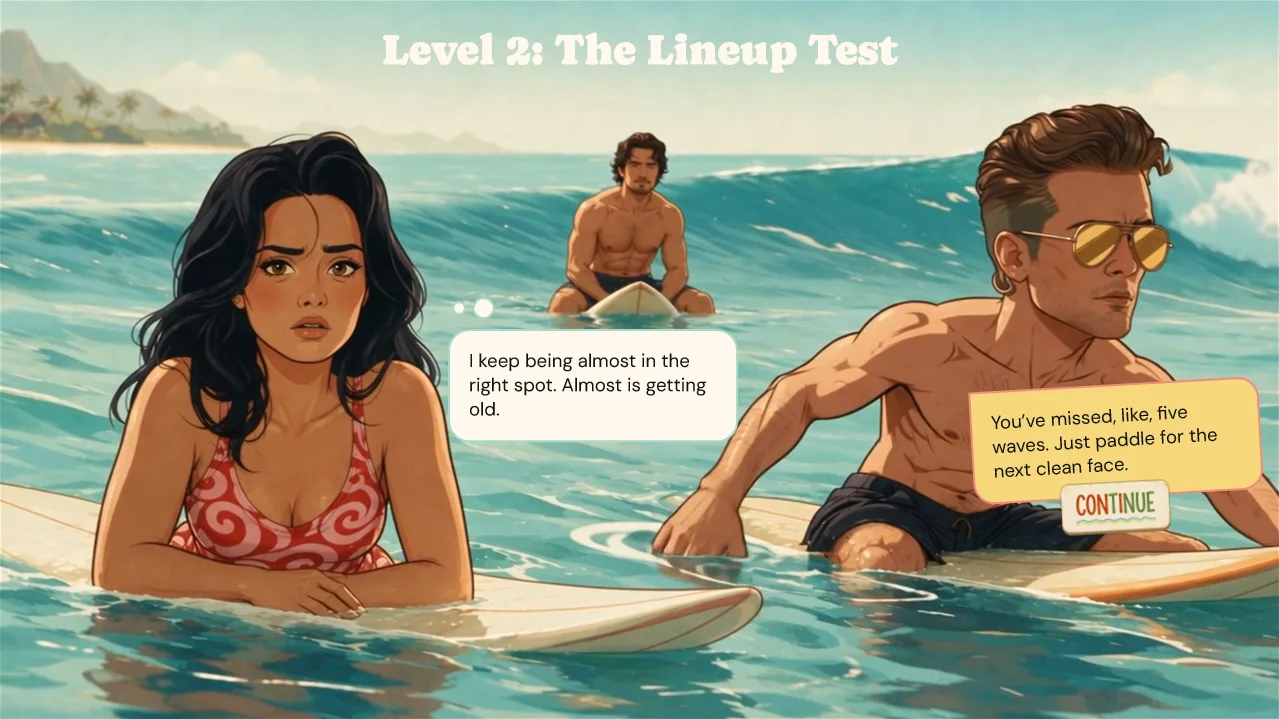
I designed Stoke & Sense as a cinematic, scenario-based surf session rather than a conventional safety course. The learner takes Abi through an unfamiliar break alongside Fran, an enthusiastic friend who adds social pressure and comic relief, and Mike, an experienced surfer who quietly models better judgement.
The experience builds around 3 escalating decisions:
Read the break
Have you watched and observed where the wave is breaking, who is deeper and what the lineup is doing?
Respect the lineup
Is this really your wave – or does someone else have priority?
Control risk
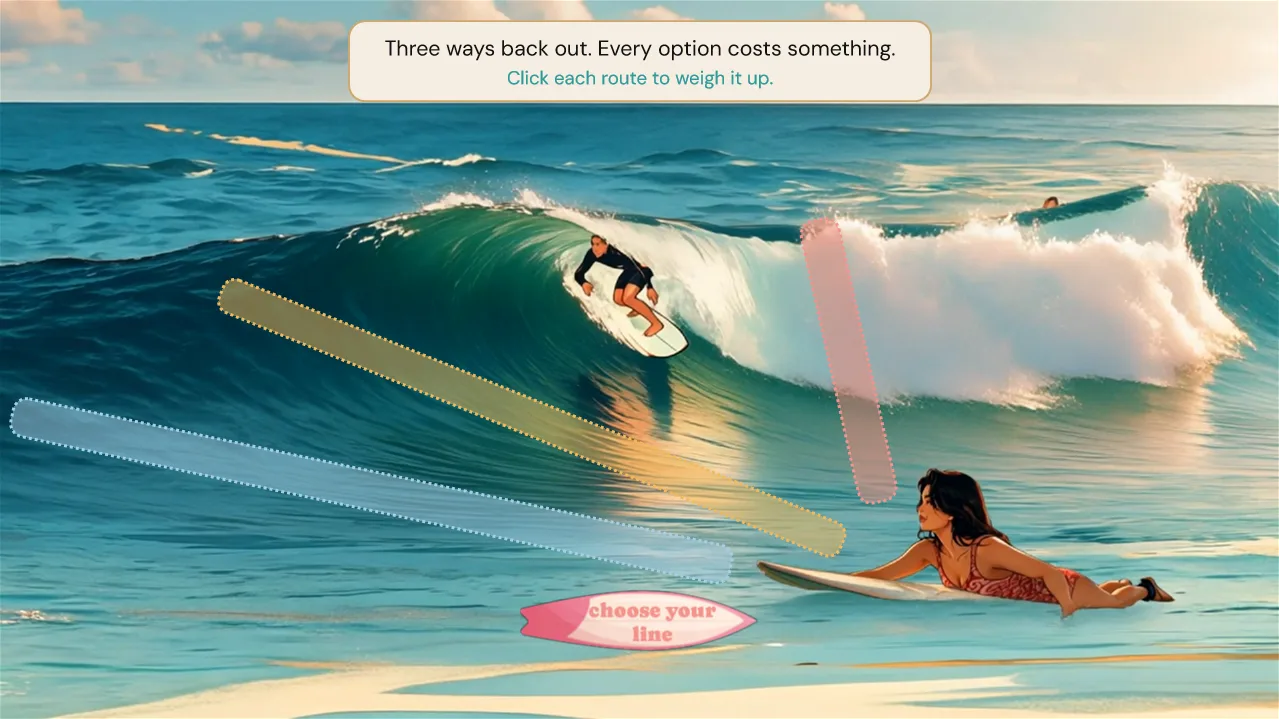
What paddle line gets you back out without crossing the path of a surfer already riding?
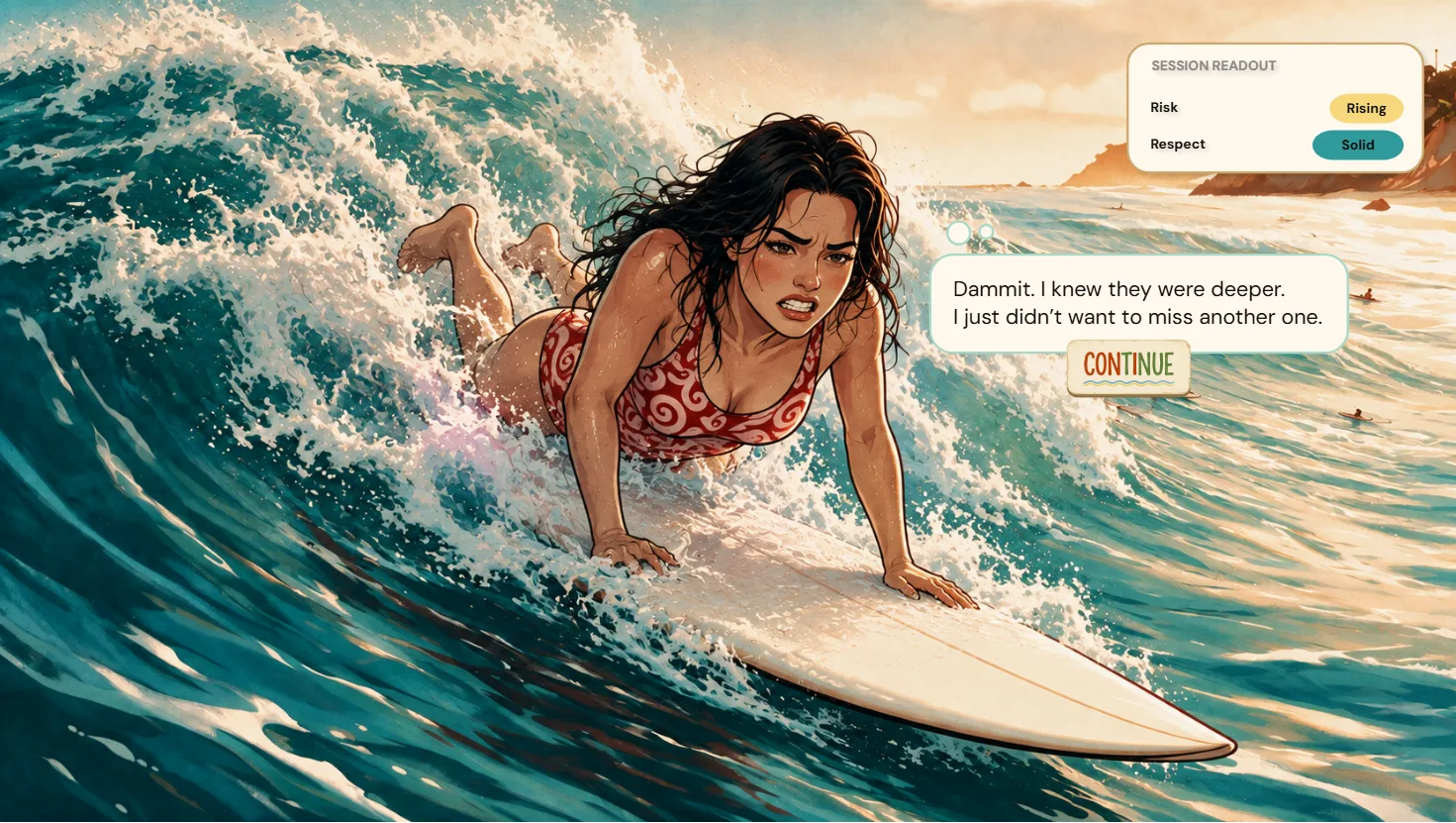
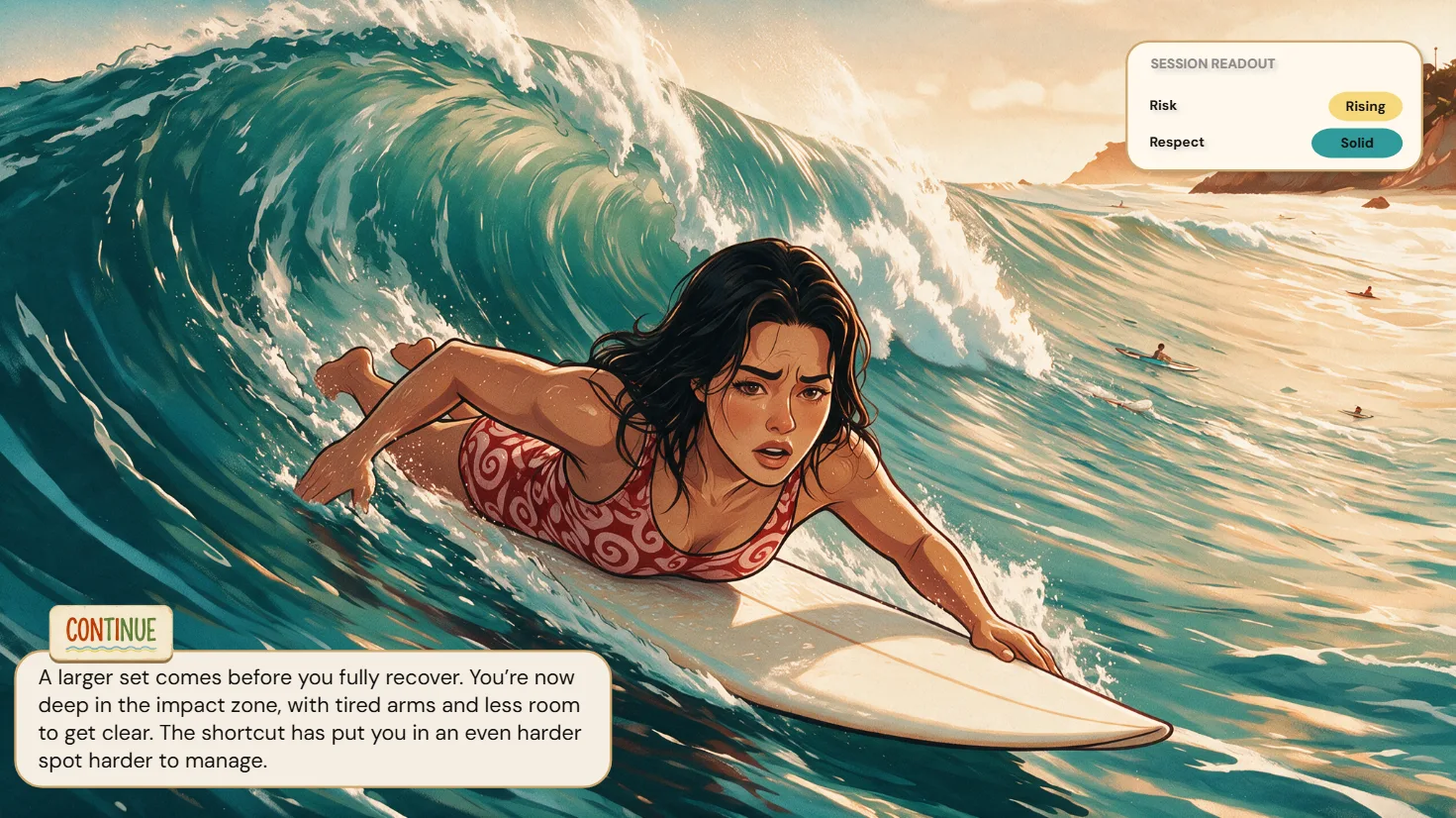
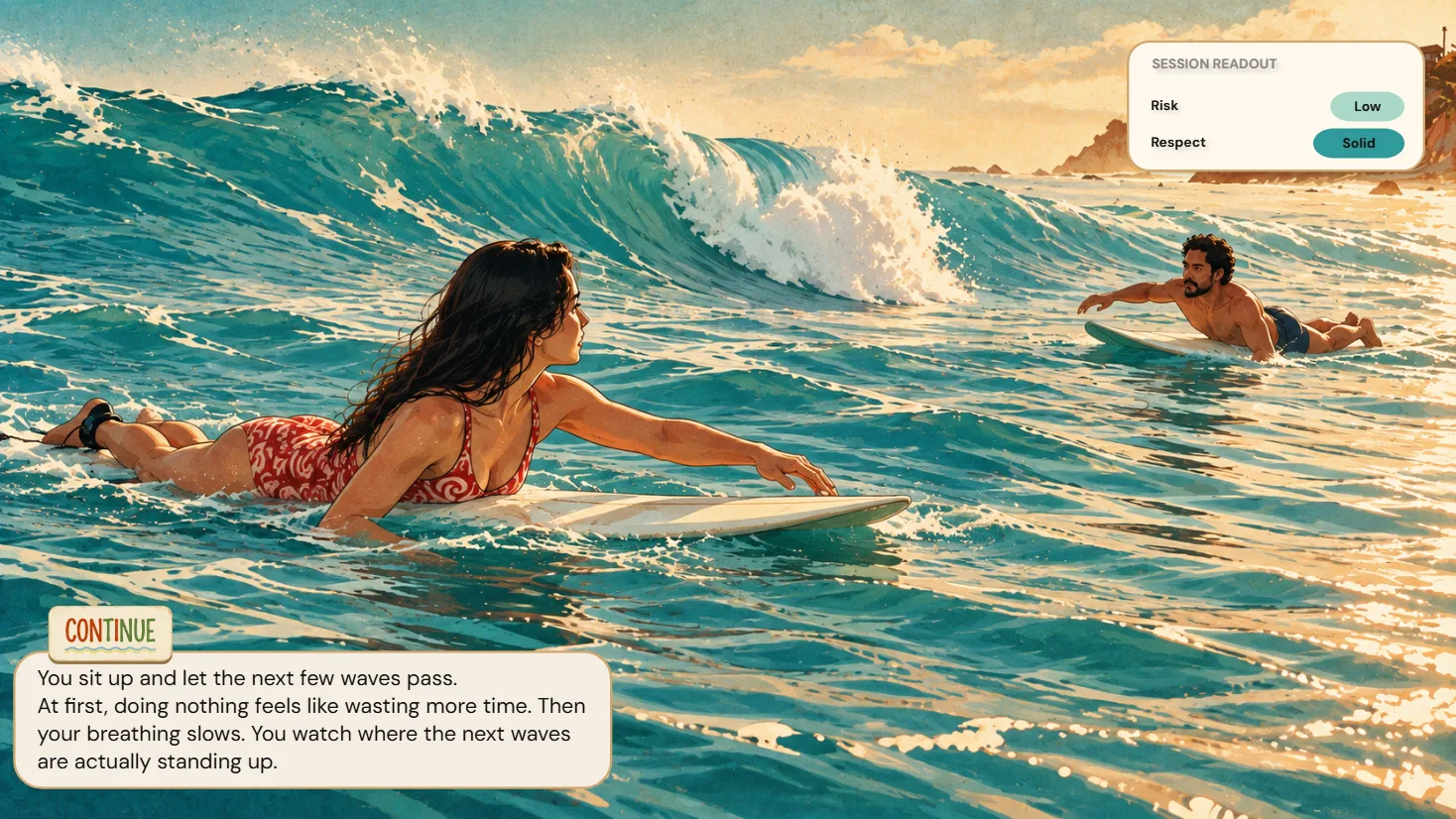
Learners scan scenes for visual clues, make choices and see the consequences play out immediately. There are no big Correct or Incorrect screens. Feedback comes through the consequences: how the wave plays out, how the lineup shifts and how other surfers react.
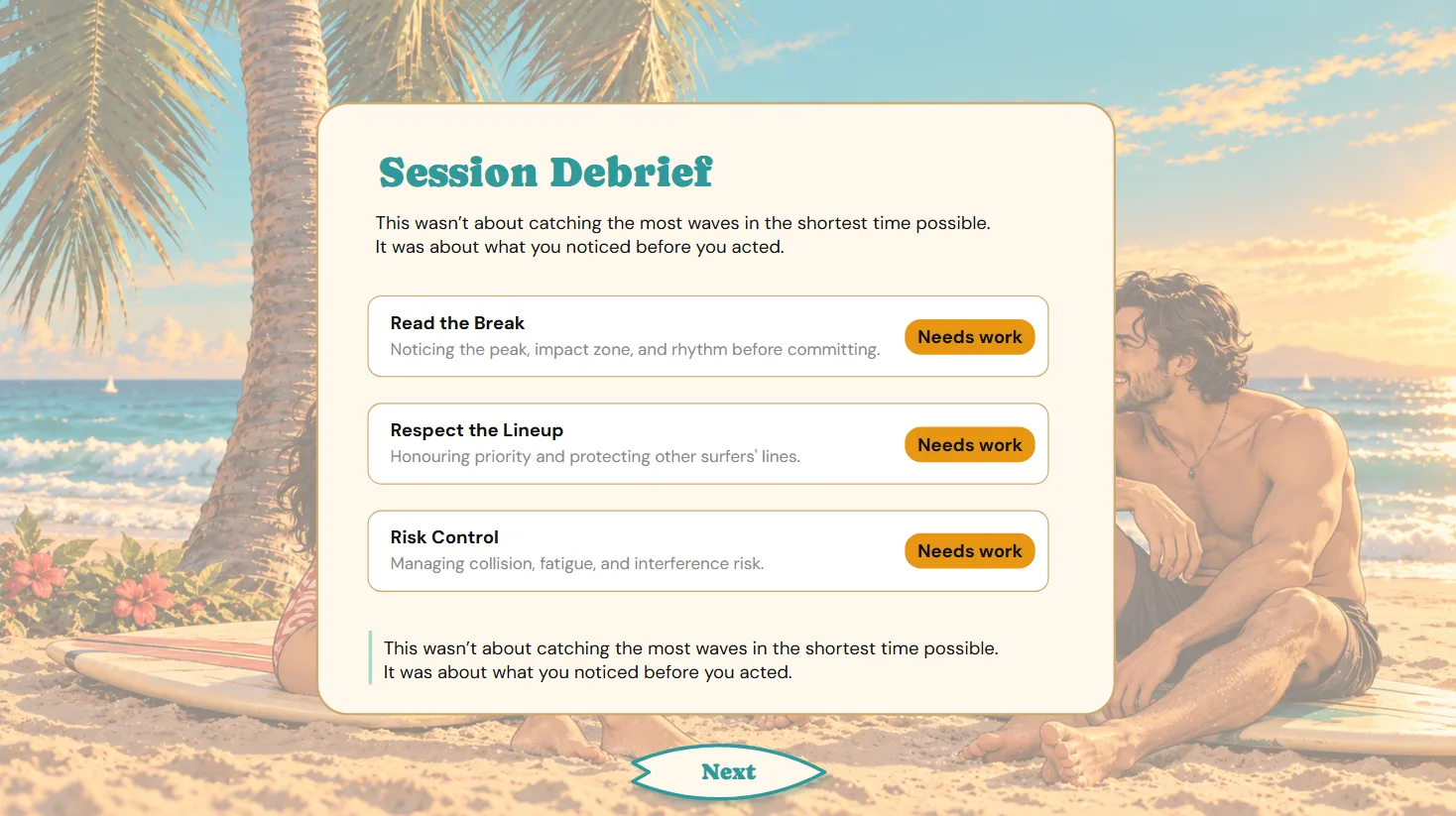
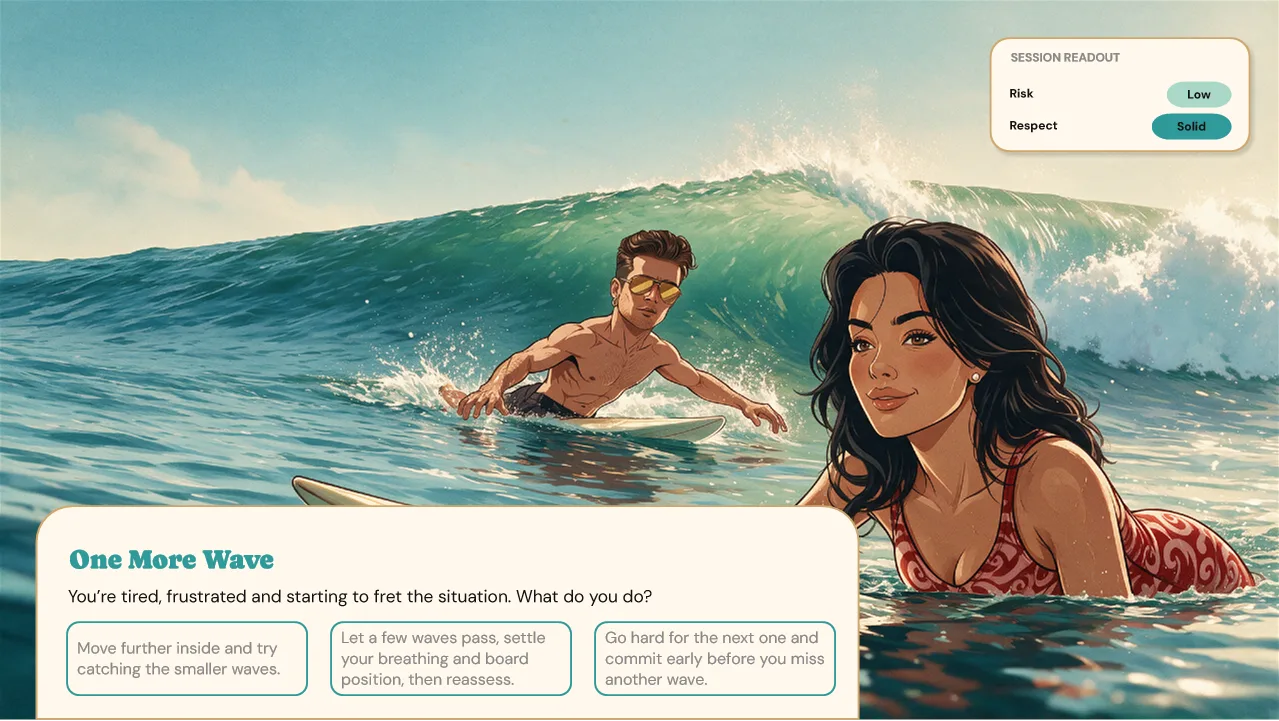
A cumulative Session Readout tracks how risk and lineup respect develop across the session rather than resetting after each challenge. The final debrief looks at three behaviours – Read the Break, Respect the Lineup and Risk Control – without turning the experience into a points game.
The aim isn’t to memorise another set of surf rules.
It’s to practise seeing the situation before making the move.
03 – Process
From safety message to surf judgement.
Analyse
Find the decision behind the danger
Defined the performance problem around judgement in the water, rather than simply knowledge of surf-safety rules.
Design
Build pressure into the decisions
Mapped three escalating challenges around realistic moments where observation, emotion and surf etiquette collide.
Develop
Build the session, not the quiz
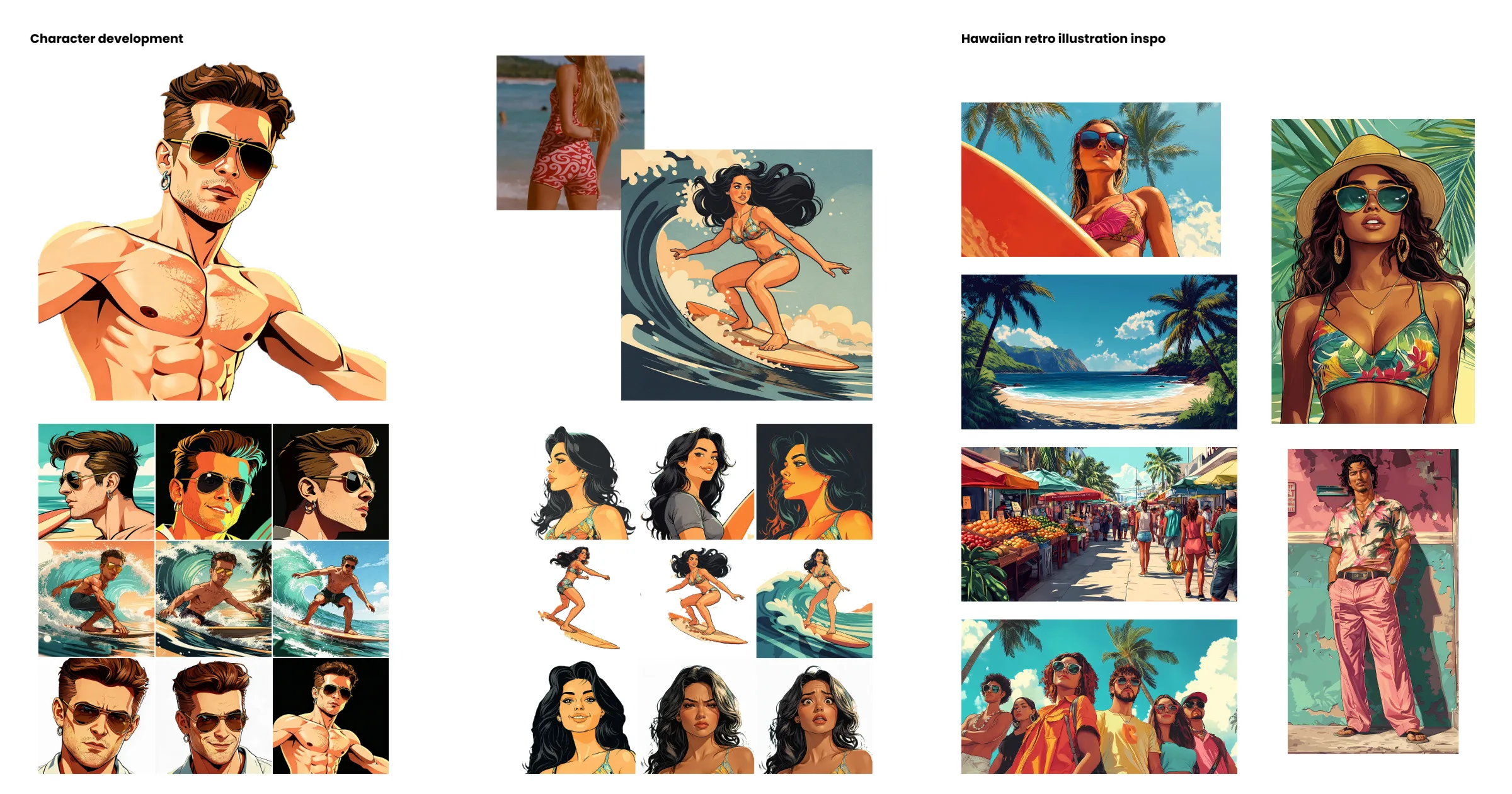
Created the characters, visual system, consequence layers and Storyline logic that turn each decision into part of one continuous surf session.
Implement
Put the experience in motion
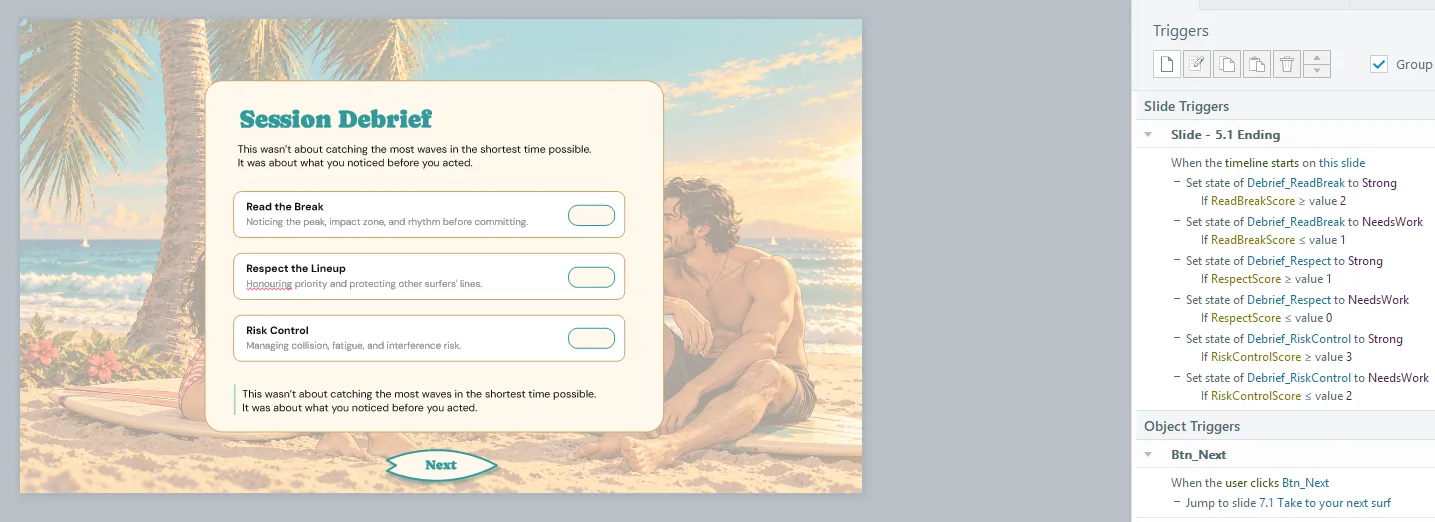
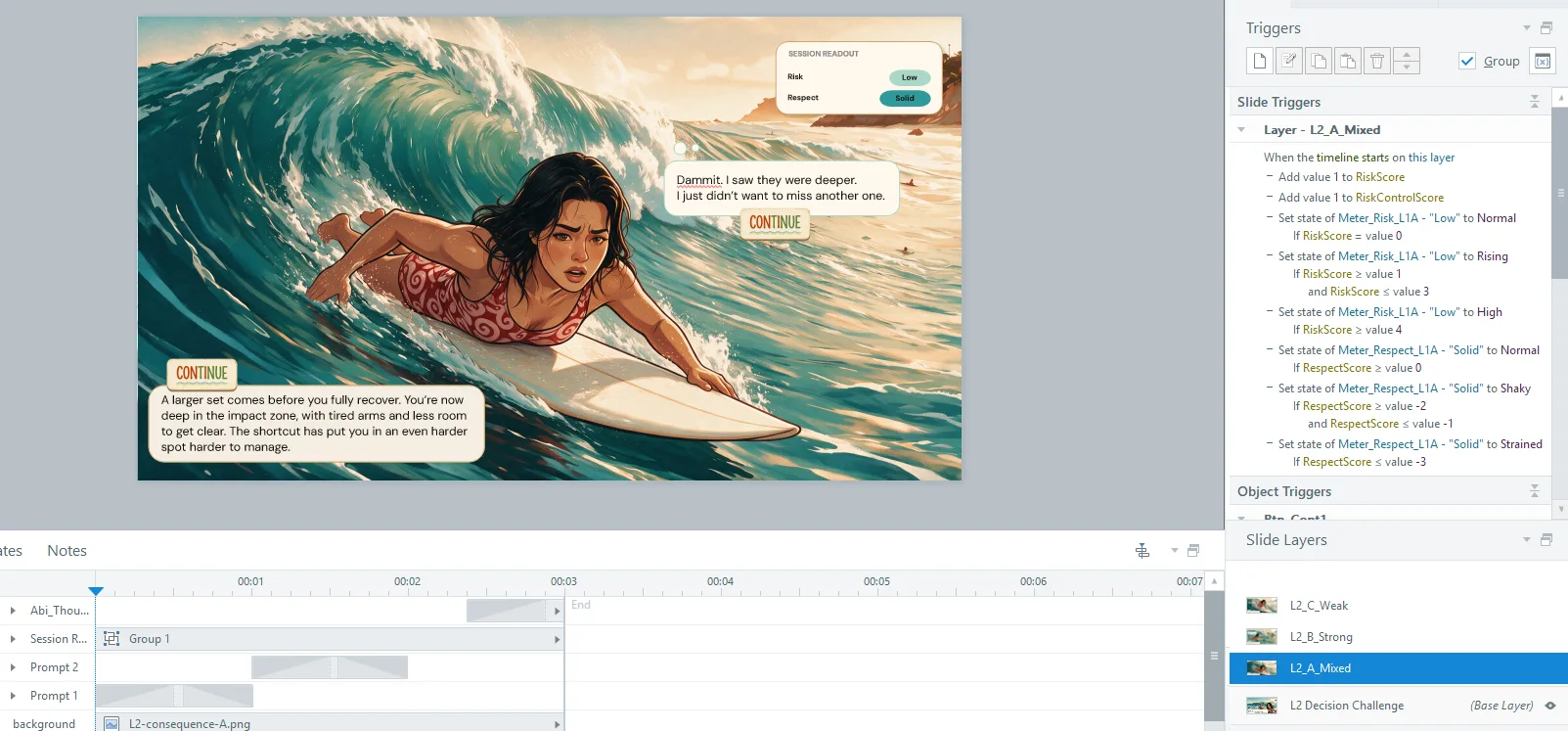
Connected the interactions, cumulative variables and feedback system so earlier decisions continue to shape what the learner sees.
Evaluate
Test what helps judgement
Reviewed the experience for clarity, pacing and cognitive load – keeping interactions that supported the decision and simplifying those that competed with it.
Process in practice
Each process phase,
walked through
end to end.
01 · Work backwards from the outcome
I started by separating surf-safety information from the behaviours that actually keep someone safer in the water.
The learner didn’t need another catalogue of rules. They needed to recognise what was happening around them and make sensible calls before excitement, fatigue or frustration took over.
That led to three performance areas: reading the break, respecting the lineup and controlling risk. Each could be observed through a decision rather than tested through recall.
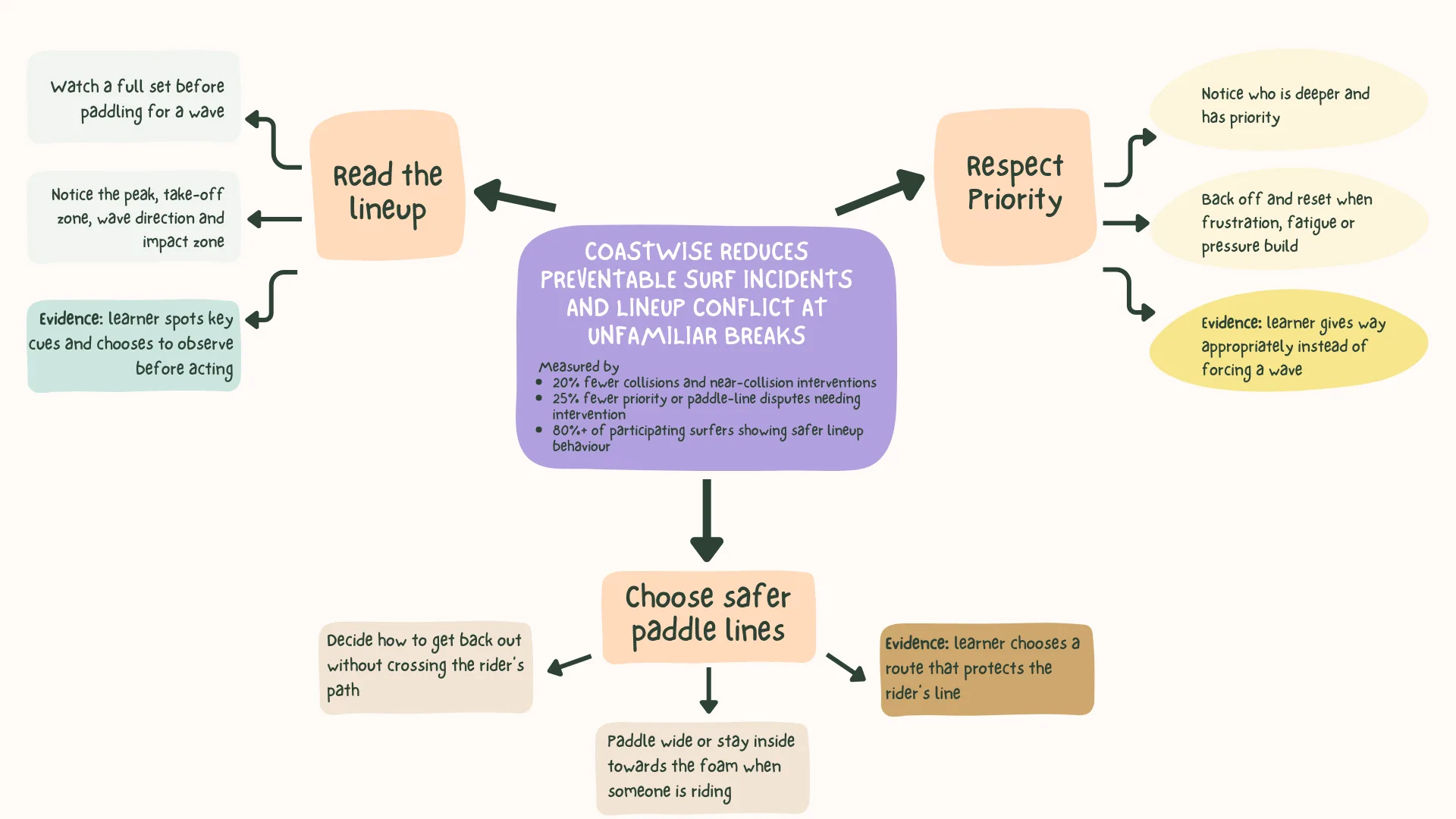
Action mapping gave the project its central design question:
What does the learner need to notice before they act?
02 · Turn the behaviours into decisions
With the three high-leverage surf decisions defined, I mapped the experience around realistic pressure: excitement, frustration, fatigue and the temptation to take the easier route.
Read the lineup became the choice to pause and observe before taking a wave. Respect priority became the decision to back off when another surfer was deeper. Choose safer paddle lines became the choice between the quickest route back out and the route that avoided a collision with the rider’s line.
I then built realistic pressure around those decisions. Abi starts excited and confident, but missed waves, frustration, fatigue and Fran’s encouragement make the safer option progressively harder to choose.
Each challenge follows the same rhythm: observe → decide → experience the consequence → reset. Strong, mixed and weak choices create different outcomes, while giving learners repeated practice recognising when safer behaviour matters.
03 · Build it. Then make it useful beyond the course
I built the scenario in Storyline around three different interaction types: visual lineup scans, branching decisions and a spatial paddle-route challenge. Consequence layers, character reactions and the cumulative Session Readout let feedback stay inside the story rather than interrupting it with explanations.
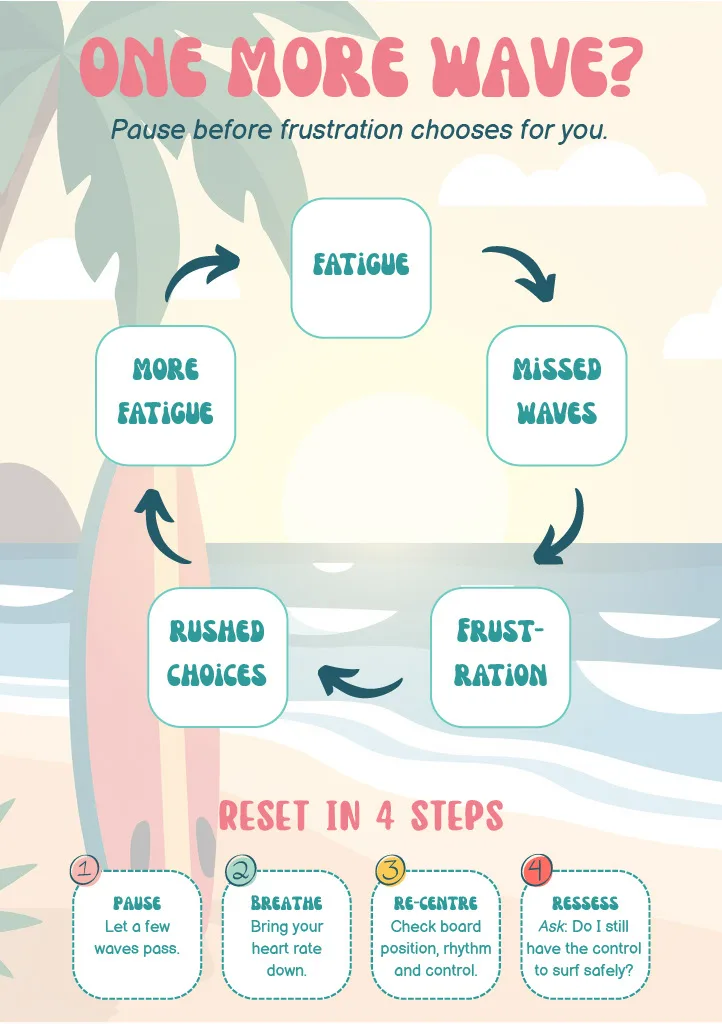
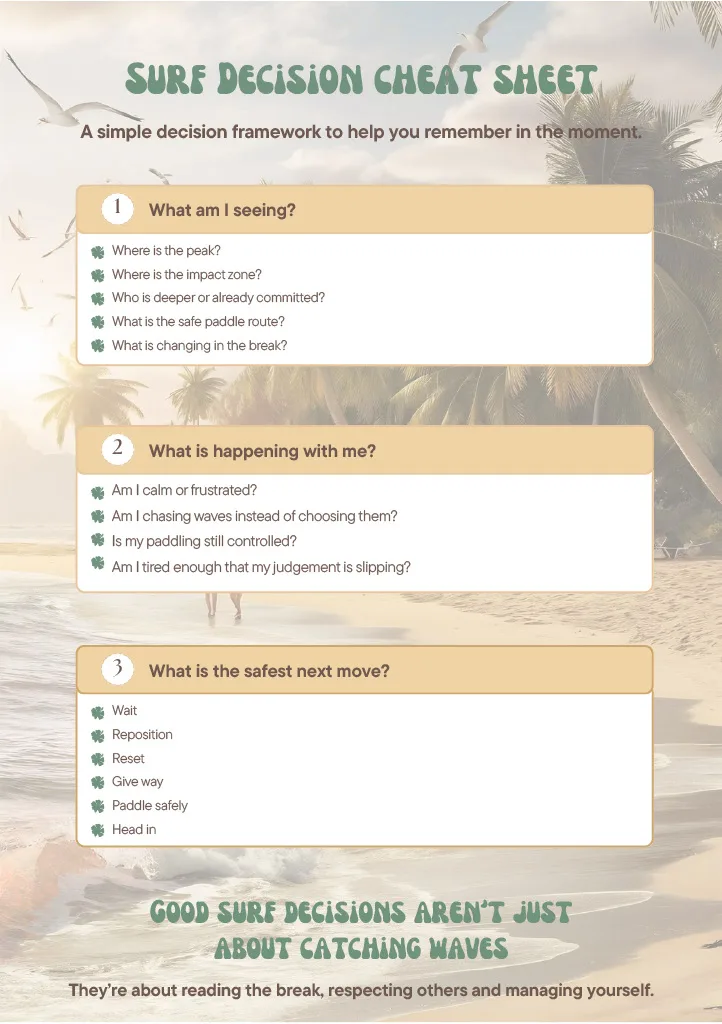
I also developed three downloadable supports: a Personal Surf-Session Reflection, a “One More Wave?” Reset infographic and a Decision Cheat Sheet.
The reflection comes first, prompting learners to connect Abi’s decisions with their own habits. Completing it unlocks the other two resources: one for resetting judgement when fatigue or frustration starts to build, and one for making faster, safer calls in future sessions.
That made the ending more than a wrap-up. It gave learners something to reflect with, remember with and use later.
 Before
After
04 · Let the whole session remember
I connected the interactions, cumulative variables and feedback system so earlier choices continue to shape what the learner sees.
Variables carry the learner’s decisions forward. Feedback layers update the Session Readout. Consequence scenes show what each choice means in context. Small resolution beats between challenges release tension and move the story forward.
I also deliberately kept conventional course UI in the background. The meter stays compact and unobtrusive; feedback happens in the scene; visual clues sit inside the lineup rather than appearing as instructional overlays.
The learner should feel like they’re making calls in the water, not progressing through three assessment questions.
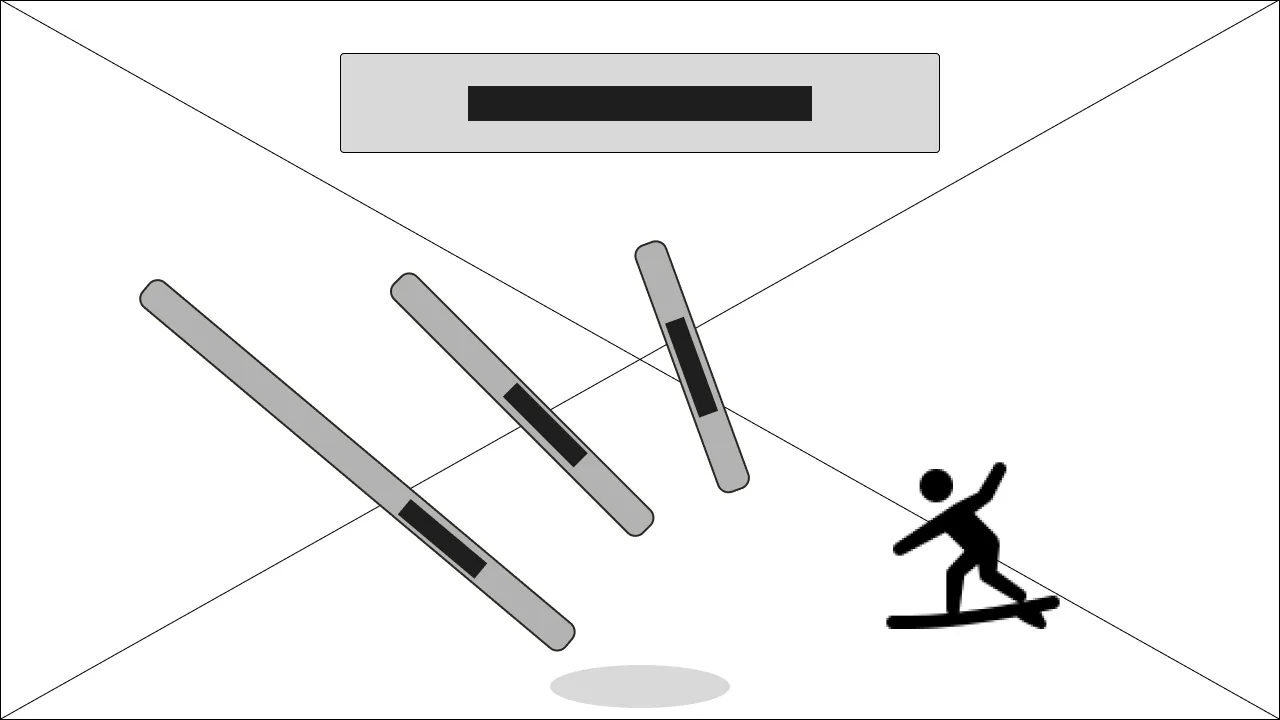 Before
After
05 · Test what supports better decisions
Evaluation focused on whether the learner could understand the situation, make the decision and interpret its consequence without the interface getting in the way.
That meant testing more than whether the Storyline triggers worked. I checked whether visual clues were noticeable without giving away the answer, whether the Strong/Mixed/Weak consequences felt credible and whether the cumulative meters still made sense several decisions later.
I also tested the emotional pacing. The comic beats, character dialogue and beautiful surf imagery needed to make the experience engaging without softening the safety message.
The test became simple:
Does this element help learners read the situation – or just give them something else to click?
Full learner path from scene transition → the challenge → 3-tiered consequence → risk/ respect meter update
04 – Results & takeaways
Because Stoke & Sense is a conceptual portfolio project, these are evaluation targets rather than claimed outcomes. A live CoastWise implementation would measure whether the experience changes the behaviours behind the original safety problem – and whether those changes lead to fewer preventable incidents and less conflict in the lineup.
20% ↓
preventable collision and near-collision incidents
80%+
of participating surfers show safer lineup behaviour in follow-up observation
25% ↓
lineup disputes needing staff intervention
I’d also look at the behaviour behind the numbers. Are surfers watching a full set before committing? Pulling off earlier when someone has priority? Choosing paddle lines that protect the rider rather than the quickest route back out?
Because fewer incidents are only part of the result.
Better judgement is.
The biggest lesson from Stoke & Sense was that realistic pressure makes a scenario more useful than added complexity.
The three challenges are technically quite different – hotspot observation, branching choices and a spatial drag-and-drop – but the interaction itself was never the point. What made each decision meaningful was the pressure around it: excitement, frustration, fatigue, social influence and the temptation to take the easier route.
I also saw how much stronger feedback becomes when it stays inside the story. Instead of stopping the learner to explain the lesson, I could let the consequence do the work: a tighter lineup, a missed priority call, a rider forced to adjust or a safer route that costs more effort.
The question I’d carry into future scenario-based projects is:
What makes the wrong decision feel tempting?
Want a result like this?
Get in touch ↗
Before
After
Drag the handle · ← → keys · Esc to close
Before
After
Drag the handle · ← → keys · Esc to close